

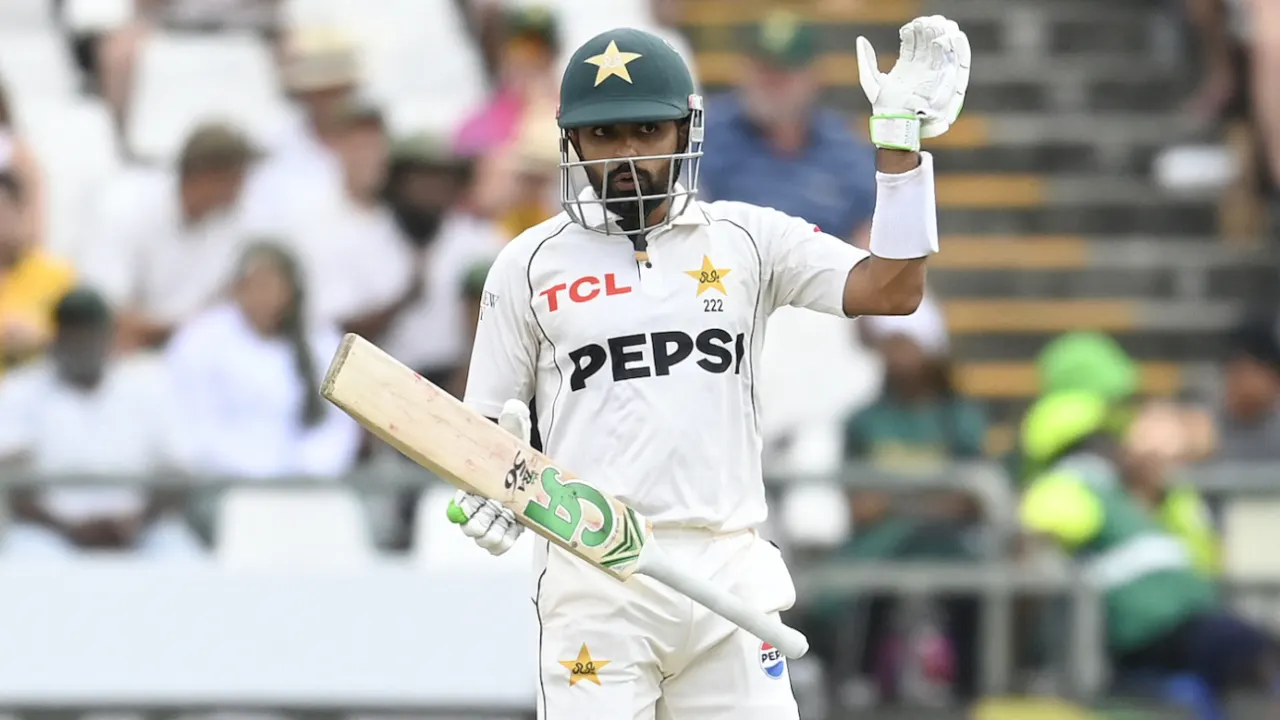
Pakistan cricket has once again turned to one of its most accomplished modern-day cricketers, with Babar Azam returning as the national team’s Test captain after Shan Masood was removed from the role following a disappointing tenure. The decision, announced alongside Pakistan’s squad for the upcoming Test tours of the West Indies and England, signals a significant reset in the country’s red-ball setup.
Babar’s return to leadership comes at a crucial juncture for Pakistan cricket, with the team currently languishing at the bottom of the World Test Championship standings. Alongside the captaincy change, the selectors have made several bold decisions, including dropping senior players such as Shaheen Shah Afridi, Hasan Ali, and Noman Ali while introducing a new generation of talent.
Babar Azam Gets a Second Opportunity
Nearly three years after stepping away from Test captaincy, Babar Azam has been entrusted once again with the responsibility of leading Pakistan in the longest format. His immediate challenge will be guiding Pakistan through a demanding overseas schedule, beginning with a two-Test series in the West Indies before a high-profile three-match tour of England.
The appointment reflects the Pakistan Cricket Board’s belief that Babar remains the country’s best leadership option despite his recent struggles with the bat in Test cricket. During his previous stint as captain, Babar led Pakistan in 20 Test matches, winning ten and establishing himself as one of the more successful captains in the country’s recent history.
His earlier tenure featured notable achievements, including series victories over South Africa, Bangladesh, and Sri Lanka. However, it also included disappointments, most notably the historic 3-0 home whitewash against England.
The selectors will now hope that the return of captaincy responsibilities can help revive both Babar’s leadership influence and his batting form, which has dipped considerably over the past two years.
Shan Masood Pays the Price for Poor Results
While Shan Masood retains his place in the playing squad, his removal as captain comes after one of the most difficult leadership spells in Pakistan’s Test history.
Since taking charge in December 2023, Masood captained Pakistan in 16 Test matches and suffered defeats in 12 of them. Pakistan’s inability to close out matches, combined with a prolonged losing streak, ultimately convinced the selectors that a leadership change had become unavoidable.
Former Pakistan captain and current selector Misbah-ul-Haq emphasized that consistency in results remains the most important factor when evaluating leadership performance.
According to Misbah, the team failed to achieve the desired level of success under Masood, making changes necessary despite the board’s preference for stability.
Interestingly, Masood’s own batting performances improved during his captaincy tenure, but the overall team results overshadowed his personal contributions.
Pakistan Drop Several Senior Players
Perhaps the biggest talking point after the captaincy change has been Pakistan’s decision to drop several established names from the Test squad.
Fast bowlers Shaheen Shah Afridi and Hasan Ali, along with experienced spinner Noman Ali, have all been left out. The exclusions represent a significant shift in Pakistan’s red-ball strategy and indicate that selectors are prioritizing performance and conditions over reputation.
Pakistan’s High-Performance Director and selector Aqib Javed explained that concerns regarding the pace and effectiveness of the bowling attack played a major role in the decision-making process.
During Pakistan’s recent Test series against Bangladesh, several senior fast bowlers experienced a noticeable drop in pace as matches progressed. According to Aqib, speed gun analysis conducted during training camps highlighted the need for fresher and faster bowling options.
“We are concerned about the pace of our fast bowlers,” Aqib stated, emphasizing that maintaining speeds above 130 km/h deep into Test matches remains crucial for success in overseas conditions.
ALSO READ-Brar’s 10-Wicket Match Haul Powers India A to Series Victory
End of the Road for Shaheen?
The omission of Shaheen Shah Afridi represents one of the most significant decisions taken by Pakistan selectors in recent years.
Once considered among the world’s premier fast bowlers, Shaheen has struggled to recapture his best form since returning from a serious knee injury in 2023. His performances in Test cricket have declined considerably, with the left-arm pacer managing just 27 wickets in his last 16 Test innings at an average exceeding 40.
His struggles were particularly evident during the Bangladesh series, where he failed to make a decisive impact and was eventually dropped for the second Test.
Despite the omission, Aqib Javed stressed that Shaheen remains an important player for Pakistan cricket but suggested that workload management and format specialization may become increasingly relevant considerations moving forward.
The introduction of format-specific central contracts by the Pakistan Cricket Board appears to support this strategic approach.
New Faces Receive Their Opportunity
With several senior players omitted, Pakistan have chosen to invest in emerging talent.
The most exciting inclusion is 20-year-old fast bowler Ubaid Shah, younger brother of fellow cricketers Naseem Shah and Hunain Shah. Since making his first-class debut in late 2024, Ubaid has claimed 72 wickets in just 16 matches, attracting considerable attention for his pace and aggression.
Selectors hope his ability to consistently bowl at high speeds will strengthen Pakistan’s pace attack during the upcoming overseas tours.
Another notable addition is left-arm spinner Ali Usman, who earned his maiden call-up after outstanding domestic performances. The 33-year-old enjoyed an exceptional season, finishing as the leading wicket-taker in the Quaid-e-Azam Trophy with 48 wickets at an average of just over 21.
Middle-order batter Awais Zafar has also received his first international opportunity following consistent performances in domestic cricket. The 26-year-old has accumulated more than 2,200 first-class runs at an average approaching 43, including seven centuries.
The recalls of Mohammad Ali and all-rounder Aamir Jamal further strengthen the squad’s depth and experience.
Saud Shakeel’s Absence Creates Opportunity
Pakistan have also been forced into a change due to fitness concerns, with Saud Shakeel unavailable for the West Indies series.
The left-hander endured a disappointing series against Bangladesh, scoring just 29 runs across four innings. While he remains part of the squad for the subsequent England tour, his participation will depend on his recovery.
His temporary absence has opened the door for Awais Zafar to stake a claim for a permanent place in the middle order.
Challenging Tests Ahead
Babar Azam returns to leadership at a particularly demanding time for Pakistan cricket.
The two-Test series against the West Indies begins on July 25 at the Brian Lara Cricket Academy in Tarouba, followed by the second Test at the Queen’s Park Oval starting on August 2.
After completing the Caribbean tour, Pakistan will travel to England for a challenging three-match series scheduled at Headingley, Lord’s, and Edgbaston.
The selectors have indicated that the current squad has effectively been chosen for the next five Test matches, meaning performances during these tours could significantly shape Pakistan’s Test future.
A Defining Moment for Pakistan Cricket
The decision to restore Babar Azam as captain, combined with a substantial squad overhaul, represents a defining moment in Pakistan’s red-ball rebuilding process.
Pakistan’s struggles in recent years have exposed issues related to consistency, leadership, and player development. By introducing fresh talent while simultaneously returning to an experienced captain, the selectors appear to be pursuing a balance between stability and renewal.
Whether this strategy succeeds remains to be seen. However, one thing is certain: Babar Azam now faces perhaps the most important challenge of his captaincy career.
With Pakistan sitting at the bottom of the World Test Championship standings and difficult overseas tours looming, the coming months may determine not only Babar’s future as captain but also the direction of Pakistan Test cricket itself.