

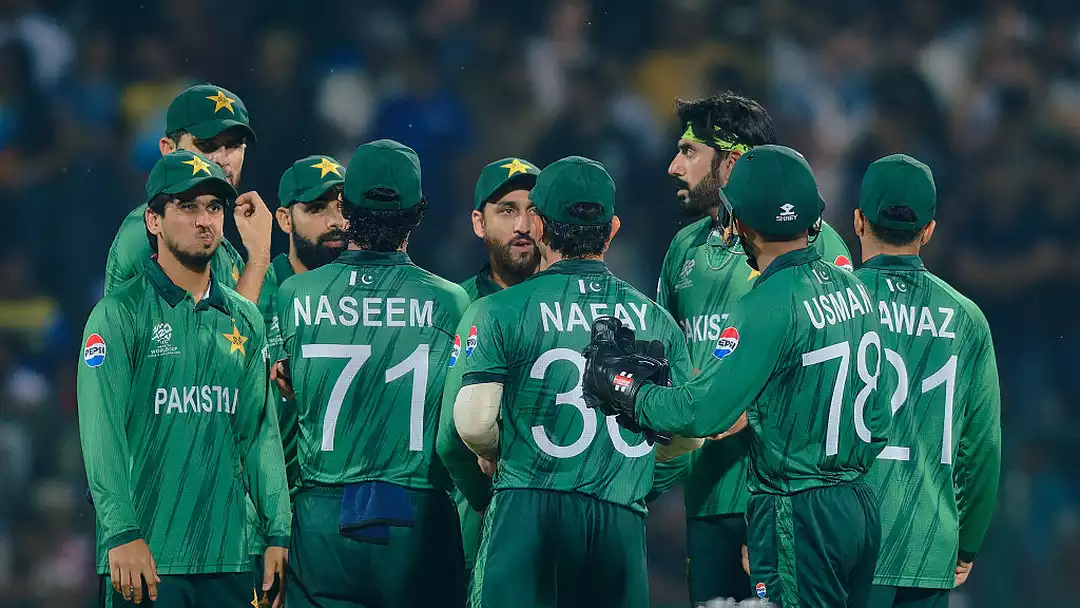
In a dramatic and unprecedented move, the Pakistan Cricket Board (PCB) has reportedly imposed hefty fines on members of the Pakistan squad following their underwhelming campaign in the ongoing T20 World Cup. According to local media reports, each player has been fined PKR 5 million, a collective penalty that has sparked debate across the cricketing landscape.
While some reports claim the fines were triggered specifically by Pakistan’s heavy 61-run defeat to India, there remains uncertainty about the exact reasoning and timing behind the decision. The PCB has yet to issue an official clarification, and a spokesperson did not respond to media queries regarding the matter.
Conflicting Signals Over Timing and Rationale
The controversy appears to center on whether the fines were imposed immediately after the loss to India or as a broader reaction to Pakistan’s overall World Cup performance. One local outlet reported that officials made the call right after the India defeat, conveying a strong message that “enough leniency has been shown” and that financial benefits would henceforth be strictly performance-based.
However, the situation is not entirely straightforward. Pakistan’s tournament was not devoid of bright spots. Individual players delivered noteworthy performances even as the team struggled for consistency. The blanket nature of the penalty — reportedly applied uniformly across the squad — has therefore raised questions about fairness and proportional accountability.
Compounding the confusion is the reported absence of any fine-related clause in the central contracts issued to players. If accurate, that detail could open the door to further scrutiny regarding the procedural legitimacy of the board’s decision.
A Campaign of Mixed Performances
Pakistan’s World Cup journey was far from a complete collapse, though it ultimately ended in disappointment. After a crushing loss to India in the group stage, the team recovered sufficiently to qualify for the Super Eight phase.
In that stage, Pakistan won one match, lost one, and had a crucial fixture against New Zealand washed out due to weather. The points table told a painful story: both Pakistan and New Zealand finished with three points, but New Zealand advanced to the semifinals courtesy of a superior net run rate (NRR).
Pakistan’s only Super Eight victory came against hosts Sri Lanka. However, the margin of that win proved insufficient to overhaul New Zealand’s NRR advantage. It was a stark reminder that in modern ICC tournaments, dominance is often measured not just in wins, but in the scale of those wins.
Standout Performers Amid Team Struggles
Despite the team’s inability to reach the semifinals, several players delivered performances worthy of recognition.
Sahibzada Farhan was one of Pakistan’s most consistent batters, showcasing composure and aggression in equal measure. His ability to anchor innings while maintaining tempo stood out in high-pressure matches.
Fakhar Zaman also played impactful knocks at crucial moments, offering the kind of attacking impetus Pakistan have long relied upon in T20 cricket.
On the bowling front, Abrar Ahmed impressed with his variations and control, while Usman Tariq contributed with disciplined spells in tight situations.
Given these individual efforts, critics argue that a uniform financial penalty fails to distinguish between collective shortcomings and individual excellence. In elite team sports, accountability structures typically balance group responsibility with individual performance metrics. The PCB’s approach, if accurately reported, seems to have prioritized symbolism over nuance.
A Larger Pattern of Underachievement
The fines cannot be viewed in isolation. Since reaching the final of the 2022 T20 World Cup, Pakistan have struggled to replicate that level of success in global white-ball tournaments. They have now failed to reach the semifinals in four consecutive ICC events.
For a cricketing nation with immense talent and passionate support, such a trend inevitably invites scrutiny from administrators and stakeholders. Financial penalties, in this context, may be intended as a wake-up call — a signal that incremental progress is no longer sufficient.
Yet punitive measures in professional sport are rarely straightforward solutions. Performance volatility in T20 cricket is common, and fine margins — such as net run rate differentials — can determine outcomes beyond pure win-loss records.
ALSO READ –Sanath Jayasuriya Steps Down as Sri Lanka Head Coach After World Cup Exit
Governance, Contracts, and Player Relations
One of the most contentious aspects of the situation is the reported absence of a contractual clause permitting such fines. If confirmed, this could create friction between the board and the players’ representatives.
Professional sports governance typically operates within clearly defined contractual frameworks. Deviating from agreed terms risks legal complications and could strain dressing room morale. Transparent communication from the PCB will therefore be essential in the coming days.
Without official confirmation or explanation, speculation continues to dominate the narrative. Was this a disciplinary measure linked solely to the India defeat? Or was it a broader judgment on sustained underperformance in ICC events?
The PCB’s reported action sends a strong message about accountability and expectations. However, whether financial penalties translate into improved performance remains uncertain.
For Pakistan, the immediate priority will be restoring stability, both on and off the field. Strategic clarity in selection, tactical adaptability in high-pressure matches, and improved net run rate management must all become focal points.
As the debate unfolds, one thing is clear: this decision marks a significant moment in Pakistan cricket administration. Whether it becomes a turning point or a flashpoint will depend largely on transparency, communication, and the team’s response in future tournaments.