

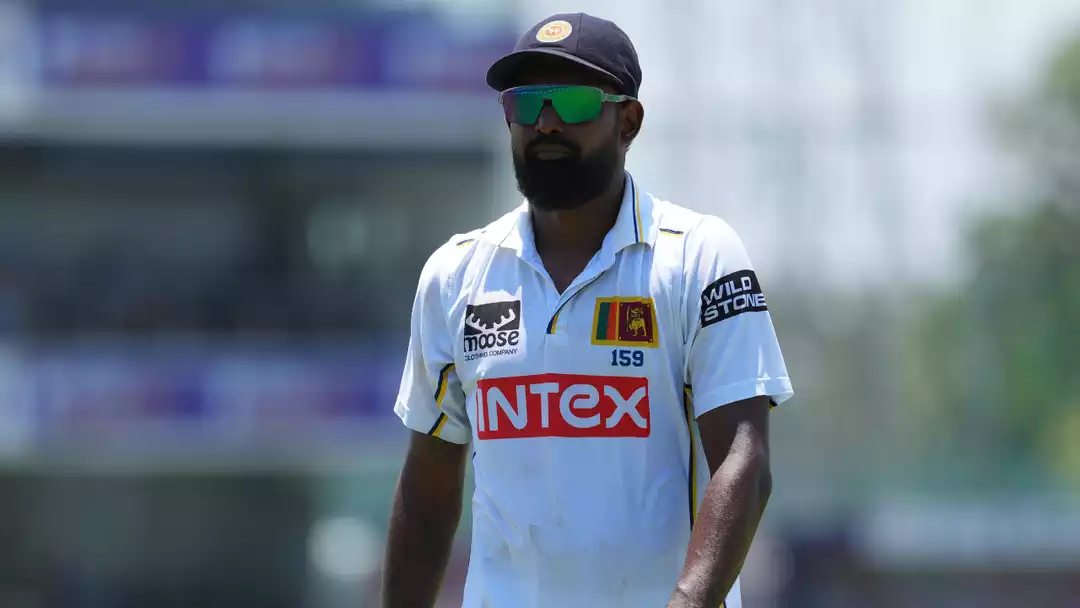
Sri Lanka left-arm spinner Prabath Jayasuriya has been officially sanctioned by the International Cricket Council (ICC) for breaching the governing body’s Code of Conduct during the second Test against India in Colombo. The spinner was reprimanded and awarded one demerit point after striking the boundary wedges with his bat following his dismissal on the final delivery of the day’s play.
The incident occurred on Monday, August 24, at a tense stage of the Test match. Jayasuriya had just been dismissed and appeared visibly frustrated while making his way back towards the pavilion. During his walk back, he hit the boundary wedges with his bat, an action that brought him under the scrutiny of the match officials.
The ICC subsequently charged Jayasuriya under Article 2.2 of the ICC Code of Conduct for Players and Player Support Personnel. The article covers the misuse or abuse of cricket equipment, clothing, ground equipment, fixtures or fittings during an international match.
Prabath Jayasuriya Receives Official Reprimand and One Demerit Point
Jayasuriya admitted the offence and accepted the sanction proposed by match referee Andy Pycroft. Because he accepted the charge and the proposed punishment, there was no need for a formal hearing.
The punishment remains relatively minor. Jayasuriya received an official reprimand and one demerit point on his disciplinary record. Since this was his first offence during the previous 24 months, the ICC did not impose a financial penalty.
However, the demerit point will remain relevant for future disciplinary matters. If Jayasuriya commits another offence during the applicable monitoring period, the accumulated points could contribute to a more serious sanction.
The charge was raised by the match officials, with on-field umpires Ahsan Raza and Sharfuddoula Ibne Shahid, third umpire Rod Tucker and fourth umpire Prageeth Rambukwella all reporting the incident.
What Happened to Prabath Jayasuriya?
The incident took place immediately after Jayasuriya’s dismissal at the end of play. Having lost his wicket on the final ball of the day, the Sri Lankan spinner was clearly disappointed with the outcome.
As he headed towards the pavilion, Jayasuriya struck the boundary wedges with his bat. While the action did not involve another player or lead to any physical confrontation, it fell within the ICC’s regulations concerning inappropriate use of cricket equipment and match fixtures.
International cricket is played under intense pressure, and emotional reactions following dismissals are not unusual. However, players are expected to maintain control and ensure that their frustration does not result in conduct that breaches the Code of Conduct.
In Jayasuriya’s case, his willingness to accept responsibility helped bring the matter to a quick conclusion.
Jayasuriya Becomes Third Player Sanctioned in Colombo Test
Jayasuriya is the third player to face disciplinary action during the second Test between India and Sri Lanka.
Earlier in the match, India’s Yashasvi Jaiswal and Sri Lanka’s Asitha Fernando were both sanctioned following an on-field confrontation during the opening day.
Jaiswal and Fernando were each fined 25 per cent of their match fees and received one demerit point. Their incident occurred during the 17th over of India’s first innings after Fernando dismissed Jaiswal.
Following the dismissal, Jaiswal walked towards Fernando and the two players exchanged words. The situation escalated when Fernando moved his head towards the Indian batter. Jaiswal subsequently leaned forward, resulting in head-to-head contact between the two players.
The incident was reviewed by the match officials and both players were subsequently punished under the ICC Code of Conduct.
While the Jaiswal-Fernando confrontation involved two players and was therefore considerably different from Jayasuriya’s incident, all three cases underline the ICC’s emphasis on discipline and professional behaviour during international matches.
Also Read-Mumbai Indians Appoint Zubin Bharucha
Why the Demerit Point Matters for Jayasuriya
Although one demerit point may appear insignificant, such points can become important if a player commits additional offences.
The ICC’s disciplinary system is designed to monitor repeated breaches of its Code of Conduct. Demerit points remain on a player’s record for a specified period, and accumulating enough points can result in more serious consequences, including match suspensions.
For Jayasuriya, this means the latest incident is unlikely to have an immediate impact on his availability. Nevertheless, the point will remain part of his disciplinary record and could become relevant if he is involved in another Code of Conduct violation.
The absence of a financial penalty also means that the punishment is primarily disciplinary rather than monetary.
Jayasuriya Remains Important to Sri Lanka’s Test Attack
The timing of the incident comes during an important period for Jayasuriya, who has established himself as one of Sri Lanka’s leading Test spinners.
The left-arm spinner has become a key component of Sri Lanka’s bowling attack, particularly on surfaces that provide assistance to spin. His ability to bowl long spells, create pressure and extract turn makes him an important option in the longest format.
Against India, Sri Lanka need their experienced players to perform consistently, particularly during a World Test Championship campaign in which every result can have implications for the teams’ positions in the standings.
For that reason, the focus is expected to quickly shift away from Jayasuriya’s disciplinary issue and back towards his performances with the ball.
ICC Continues to Emphasise Player Discipline
The latest sanction demonstrates how closely player behaviour is monitored during international cricket.
The ICC Code of Conduct covers a wide range of offences, from inappropriate conduct towards opponents and officials to the misuse of equipment or match facilities. The objective is not simply to punish players but also to ensure that international cricket is played in a professional and respectful environment.
Players regularly compete under enormous pressure, particularly in Test cricket where matches can stretch across five days. Frustration after a dismissal, missed opportunity or difficult spell is natural. However, the ICC expects players to manage those emotions appropriately.
Jayasuriya’s case is a clear example of how even an isolated act involving match equipment can lead to an official disciplinary consequence.
No Major Impact on Jayasuriya’s Participation
The good news for Jayasuriya and Sri Lanka is that the sanction is not severe enough to result in a suspension.
An official reprimand and one demerit point are significantly less serious than the penalties imposed for more serious or repeated breaches. Since Jayasuriya accepted the charge, the disciplinary process was also completed without the need for a hearing.
His immediate responsibility will therefore remain focused on his cricket and helping Sri Lanka compete against India.
The incident itself may have lasted only a few seconds, but it has now become another talking point from an already eventful Colombo Test.
Colombo Test Produces Plenty of Drama
The second Test between India and Sri Lanka has already produced several moments of tension. The confrontation involving Jaiswal and Fernando attracted attention early in the match, while Jayasuriya’s reaction following his dismissal provided another disciplinary episode.
With three players now sanctioned, the Colombo Test has had an unusually busy disciplinary storyline alongside the cricketing contest.
For the players and coaching staff, however, the priority remains the result. Both India and Sri Lanka are competing for important points in the current World Test Championship cycle, making every session and every individual performance significant.
Jayasuriya, in particular, will be expected to put the incident behind him and concentrate on his role as one of Sri Lanka’s principal spin options.
Final Takeaway
Prabath Jayasuriya’s ICC sanction is a reminder that emotions in international cricket must remain under control. The Sri Lankan spinner’s decision to strike the boundary wedges with his bat after being dismissed resulted in an official reprimand and one demerit point under Article 2.2 of the ICC Code of Conduct.
Because Jayasuriya admitted the offence and had no previous breach in the preceding 24 months, he avoided a financial penalty and will not face a suspension.
The incident also makes him the third player sanctioned during the Colombo Test, following Yashasvi Jaiswal and Asitha Fernando’s earlier confrontation.
For now, the matter is closed. Jayasuriya can return his full attention to cricket, where his contribution with the ball remains far more important to Sri Lanka than a moment of frustration at the end of a difficult day’s play.