

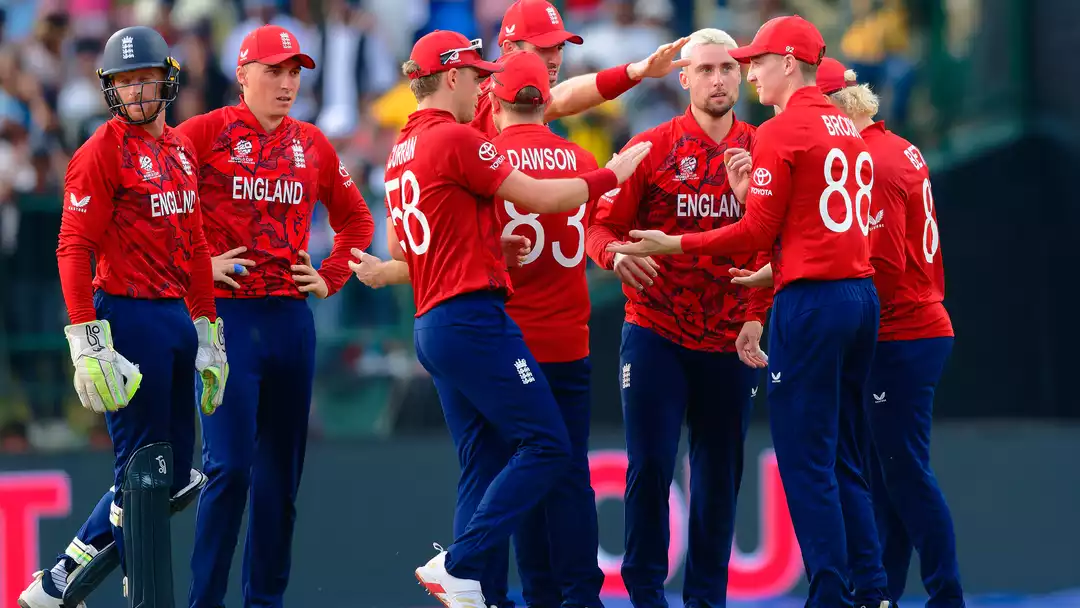
England enter their second Super Eights fixture in Pallekele with early control of Group 2, while Pakistan arrive carrying urgency. After a commanding win over Sri Lanka, England have momentum. Pakistan, meanwhile, have just a solitary point following their washout against New Zealand and cannot afford to drift if they are serious about a semifinal push.
The contest at the Pallekele International Cricket Stadium is more than a mid-group fixture; it is a strategic checkpoint. England have breathing room. Pakistan do not.
History and Context
Head-to-head numbers heavily favour England. They lead the overall T20I record 21-9 and have won all three previous T20 World Cup meetings between the sides, including the 2022 final. Psychological edges matter in tournament cricket, particularly in high-pressure group stages.However, history does not bowl overs. Conditions do.
Pallekele surfaces have consistently rewarded spin, particularly as games progress. England hold a slight experiential advantage, having played a bilateral series here against Sri Lanka and their opening Super Eights fixture at the venue. For Pakistan, this will be their first outing here in the competition — an adjustment curve they must climb quickly.
England’s win over Sri Lanka was authoritative, but not flawless. The primary concern remains their top order. Despite Phil Salt’s fluent 62 in the previous match, England’s opening pair collectively has the lowest aggregate among all Super Eights teams. Across ten innings in the tournament, they have managed just one 50-plus stand and have not batted beyond the fourth over together in any game.
That fragility becomes significant against Pakistan’s new-ball threat. Early wickets allow Pakistan to dictate tempo, especially when their seamers operate with scoreboard pressure in their favour.
Will Jacks has often bailed England out in this campaign, offering middle-order stability and acceleration. But defending champions typically prefer a stable launchpad rather than rescue operations.
Another statistical red flag for England is their vulnerability to spin. They have lost 21 wickets to slower bowlers — the most by any side in this edition — and their average against spin sits below 23. In a venue where grip and turn are part of the tactical landscape, this is not a trivial concern.
Under captain Harry Brook, England have leaned heavily into spin themselves, bowling 53.2 percent of their overs through slower options. Brook’s captaincy has yielded a 75 percent success rate — the highest among England captains with at least 10 games — and his tactical willingness to frontload spin may again shape the contest.
Pakistan’s campaign has been uneven. The washout against New Zealand denied them both rhythm and points momentum. Now, they must chase ground in a compact group.
Their most compelling positive is Sahibzada Farhan. Since January 2025, Farhan has been the most prolific T20 batter globally, amassing 2,295 runs in 62 innings at an average of 39.56 and a strike rate of 150, including five hundreds. Those numbers indicate not just consistency, but match-defining impact.
Farhan’s confidence is evident. Regarding the challenge of facing Jofra Archer, he was direct: it is “not a big deal.” That psychological clarity will be tested under lights in Pallekele.
The broader issue for Pakistan is middle-order productivity. Every other batter averages below 30 in the tournament. None has registered a fifty-plus score. That imbalance forces Farhan into an outsized role — he must provide both start and structure.
There is also intrigue around Babar Azam’s role. Head coach Mike Hesson indicated that Babar’s strike rate in World Cup Powerplays (below 100) makes him less suited to that phase. If used at No. 4 as a stabiliser, his mandate will likely be consolidation rather than acceleration — a tactical pivot that reflects Pakistan’s evolving batting philosophy.
Tactical Matchups to Watch
-
England Openers vs Pakistan New Ball
If Pakistan strike early, England’s spin issues could be magnified against Shadab Khan and Mohammad Nawaz. -
Farhan vs Archer
Archer has been lethal in the Powerplay, picking up seven wickets — joint most in that phase this tournament. England’s pacers collectively have 11 Powerplay wickets, second only to South Africa. -
Middle Overs Spin Battle
Both sides rely heavily on spin. England’s spin-heavy strategy under Brook contrasts with Pakistan’s traditional balance between seam aggression and wrist-spin control.
ALSO READ –India’s 826-Day Streak Ends in Ahmedabad Rout
Conditions and Forecast
The previous Super Eights match here saw a sticky surface after prolonged covers, making strokeplay difficult. With no rain forecast and the pitch having settled, batting conditions may improve slightly. However, spin will remain influential.
Captains will weigh whether chasing is viable on a wearing surface. Grip, turn, and variable pace could once again define the second innings.
Probable XIs
England: Phil Salt, Jos Buttler (wk), Jacob Bethell, Tom Banton, Harry Brook (c), Sam Curran, Will Jacks, Jamie Overton, Liam Dawson, Jofra Archer, Adil Rashid.
Pakistan: Sahibzada Farhan, Saim Ayub, Salman Agha (c), Babar Azam, Fakhar Zaman, Usman Khan (wk), Shadab Khan, Mohammad Nawaz, Faheem Ashraf, Salman Mirza, Usman Tariq.
Strategic Outlook
For England, this is about tightening margins. Sharper top-order returns and improved spin management would eliminate lingering vulnerabilities.
For Pakistan, it is about urgency. Another slip could reduce their semifinal pathway to mathematical improbability.
Momentum favours England. Motivation may favour Pakistan.
In tournament cricket, the side that better absorbs spin pressure — and executes in the Powerplay — usually dictates the outcome. Tuesday night in Pallekele will likely be decided not by reputation, but by adaptability.