

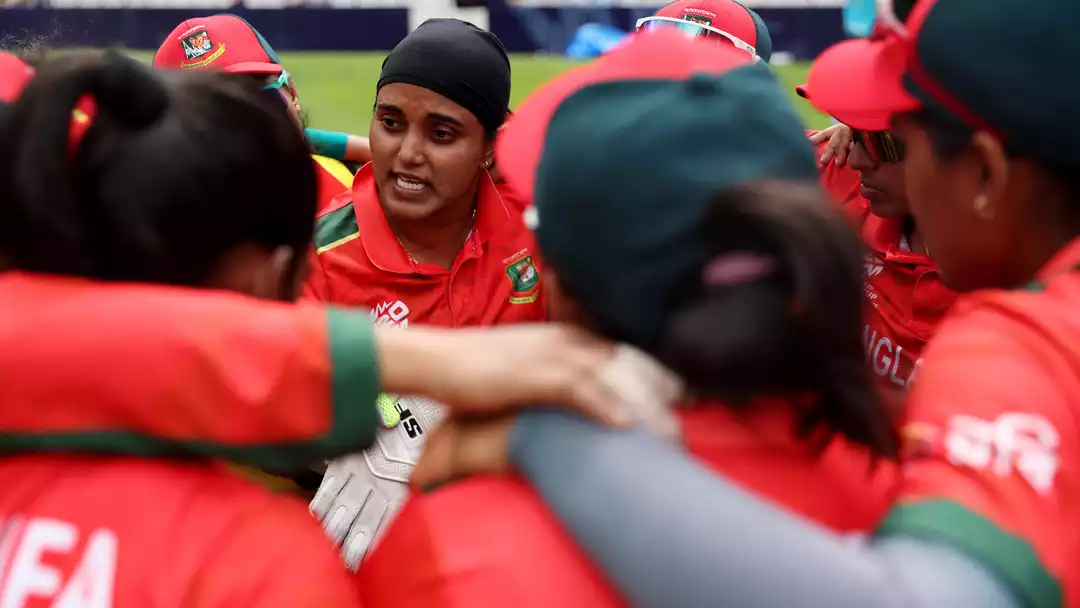
Bangladesh women’s cricket captain Nigar Sultana is set to relinquish the T20I captaincy after the Asian Games, bringing an end to her leadership of the side in the shortest format. Nigar has reportedly informed the Bangladesh Cricket Board of her decision and intends to concentrate more on her batting and wicketkeeping responsibilities.
The 28-year-old will continue to lead Bangladesh in One-Day Internationals, allowing her to remain an important figure in the national team while reducing the workload associated with captaining in T20 cricket.
Nigar formally communicated her decision to the board through a letter sent from Japan on Tuesday, September 15. The development comes during Bangladesh’s Asian Games campaign and follows a period in which the team’s results in T20 cricket have produced both encouraging progress and disappointing setbacks.
Nigar Wants to Focus on Batting and Wicketkeeping
Nigar’s decision is understood to be driven primarily by a desire to give greater attention to her individual responsibilities as a batter and wicketkeeper.
As captain, she has had to balance tactical planning, team management and match-day decision-making with her own performance behind the stumps and in the middle order. Stepping away from the T20I leadership role could allow her to focus more closely on these two areas.
Her experience remains valuable to Bangladesh, particularly in the wicketkeeping department. She has also been one of the team’s more dependable batters in major international tournaments, often taking responsibility during difficult phases of an innings.
By continuing as ODI captain, Nigar will retain a leadership role in the national setup. The decision therefore represents a change in format rather than a complete withdrawal from captaincy.
Bangladesh will now have to identify a new leader for the T20I team after the Asian Games. The board may consider an experienced senior player or a younger member of the squad who can take the team forward in the next phase of its development.
Nigar Took Over T20I Captaincy in 2022
Nigar became Bangladesh’s T20I captain in 2022 and has led the side through several important international assignments. Her tenure has included moments of progress, historic victories and periods of criticism over the team’s consistency.
One of the most significant achievements during her captaincy came at the 2024 Women’s T20 World Cup. Bangladesh defeated Scotland in the tournament to register their first World Cup victory in ten years.
The result was particularly important for Bangladesh women’s cricket, which had struggled to produce consistent wins on the global stage. The victory offered encouragement to the team and demonstrated its ability to compete successfully against established international opponents.
Nigar also played a major role in that campaign with both bat and gloves. She scored 104 runs across four innings and contributed seven dismissals as wicketkeeper. Her all-round involvement made her one of Bangladesh’s most influential players during the tournament.
The 2024 World Cup success became one of the defining moments of her leadership period and provided a strong foundation for the team’s ambitions in women’s T20 cricket.
Leadership Tenure Included Major Ups and Downs
Although Nigar’s captaincy featured important achievements, Bangladesh’s T20I results have not always been consistent.
The team enjoyed an impressive run in the 2026 World Cup qualifiers, emerging as unbeaten champions. That performance suggested that Bangladesh were building momentum and developing a stronger competitive structure in the women’s game.
However, the side subsequently experienced a series of setbacks. Bangladesh lost a home T20I series against Sri Lanka by a 2–1 margin, while their performances in the Scotland-Netherlands tri-series produced mixed results.
The team also managed only two victories from five matches at the T20 World Cup. Those results led to increased scrutiny of Nigar’s leadership and raised questions about Bangladesh’s ability to maintain momentum against stronger opponents.
T20 cricket often places additional pressure on captains because of its fast pace and limited margin for error. Decisions involving bowling changes, field placements, batting combinations and the use of inexperienced players can have an immediate effect on the outcome.
Nigar’s decision to step down from the T20I captaincy comes against this background. However, it would be inaccurate to view the move solely as a response to results. Her stated intention to focus more on her personal performance suggests that workload and role management have also influenced the decision.
Bangladesh Must Prepare for a New T20I Leader
The Bangladesh Cricket Board will now have to plan for a leadership transition in the T20I format.
The new captain will inherit a team that has shown potential but remains in the process of establishing greater consistency. Bangladesh have produced strong performances in qualifying competitions and individual matches, yet their results against higher-ranked opponents have often fluctuated.
The next captain will need to build on the progress achieved during Nigar’s tenure while addressing several areas of concern. These may include batting depth, consistency during the middle overs, death bowling and the ability to perform under pressure in major tournaments.
Leadership continuity will also be important. Nigar is expected to remain part of the team and continue as ODI captain, meaning her experience can still support the incoming T20I skipper.
A smooth transition could benefit Bangladesh if the board clearly defines the responsibilities of the new captain and maintains a stable support structure. The team may also use the next few bilateral series to test leadership options before entering another major global tournament.
Also Read-Kranti Gaud Fined 10% of Match Fee After Send-Off Gesture in Women’s Asia Cup
Nigar’s ODI Leadership Will Continue
While she is leaving the T20I captaincy, Nigar is expected to remain in charge of Bangladesh’s ODI team.
The longer format offers her a different tactical environment. ODI cricket allows greater time for batters to build innings, bowlers to operate in longer spells and captains to make strategic adjustments over 50 overs.
Nigar’s continued presence as ODI captain could provide stability to the team. It will also allow her to remain involved in leadership and decision-making without carrying the responsibilities of both formats.
For Bangladesh, maintaining Nigar as ODI captain may be a sensible approach because it preserves her experience while creating space for another player to develop as a T20I leader.
Her dual role as a batter and wicketkeeper will remain central to the team’s plans. With fewer captaincy duties in T20Is, Bangladesh will hope that she can produce more consistent performances with both bat and gloves.
Asian Games Mark the End of Her T20I Captaincy
Nigar is expected to continue leading Bangladesh in T20Is until the conclusion of the Asian Games. The tournament will therefore represent the final assignment of her tenure in the shortest format.
The Asian Games provide an important opportunity for Bangladesh to assess their squad and build confidence ahead of future international commitments. The team will aim to finish the competition strongly, while Nigar will look to complete her T20I captaincy period on a positive note.
Her decision also gives the Bangladesh team management time to prepare for the leadership change rather than making an abrupt alteration in the middle of an international series.
The board will likely announce the new T20I captain after the Asian Games. Until then, Nigar’s focus will remain on helping Bangladesh perform well in Japan and ensuring a smooth transition for the team.
A New Chapter for Bangladesh Women’s Cricket
Nigar Sultana’s decision marks the beginning of a new chapter for Bangladesh women’s cricket. Since taking over the T20I captaincy in 2022, she has overseen a period of growth that included a historic World Cup victory, an unbeaten qualifying campaign and several challenging international series.
Her departure from the T20I leadership role does not signal the end of her influence. She will continue to play a central role as an experienced batter, wicketkeeper and ODI captain.
For Bangladesh, the challenge will be to identify a successor capable of guiding the T20I side through its next stage of development. The team will need to convert its occasional strong performances into greater consistency and build a reliable foundation for future tournaments.
Nigar, meanwhile, will have the opportunity to focus more directly on her own cricket while continuing to contribute to Bangladesh’s international ambitions in the ODI format.