

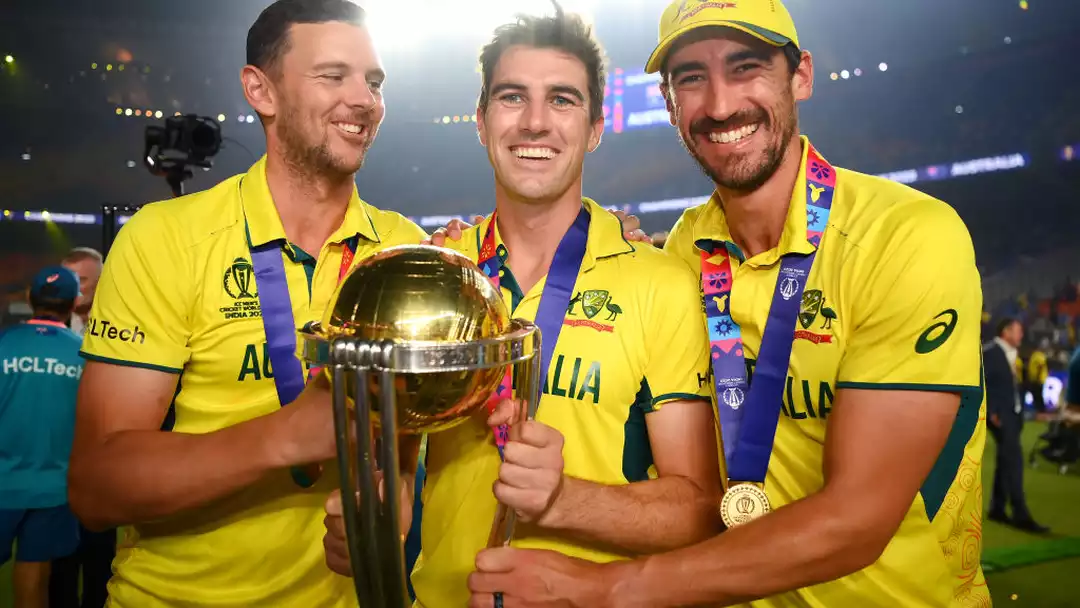
Australia national cricket team are already planning for the ICC ODI World Cup 2027, and despite growing fitness concerns surrounding their experienced fast-bowling trio, the team management remains confident that Pat Cummins, Mitchell Starc and Josh Hazlewood can still lead Australia’s pace attack at the global tournament.
The trio have been rested from Australia’s upcoming white-ball tours of Pakistan and Bangladesh, with Cricket Australia choosing workload management over short-term participation. While the decision raised questions among fans, head coach Andrew McDonald clarified that the move was part of a long-term strategy focused on preserving the fitness of Australia’s premier fast bowlers for the 2027 World Cup in South Africa.
Australia Looking Beyond Immediate Series
According to McDonald, the absence of Cummins, Starc and Hazlewood from the upcoming ODI assignments should not be viewed as a lack of commitment toward white-ball cricket.
Instead, Australia see the current period as the final major opportunity to allow the senior fast bowlers enough recovery time before an extremely demanding international schedule begins.
McDonald explained that if the team works backwards from the 2027 World Cup timeline, the present gap becomes critically important for managing the physical workload of players who have spent years across all formats of the game.
Australia are expected to play a heavy Test calendar over the next two years, and the management believes carefully planned rest periods are essential if the trio are to remain available deep into 2027.
Fitness Challenges Continue to Grow
One major concern for Australia is age and durability.
By the time the World Cup arrives:
- Mitchell Starc will be 36
- Josh Hazlewood will be 35
- Pat Cummins will be 33
Although all three continue to perform at elite level, maintaining fitness across formats has become increasingly difficult.
The issue became especially visible during IPL 2026.
Starc’s workload was closely monitored throughout the tournament, while Cummins only returned after recovering from a back stress injury. Hazlewood also battled recurring hamstring and Achilles problems during the season.
Despite these setbacks, Australia’s management remains optimistic because the trio have consistently shown resilience over long periods.
McDonald admitted the challenge is now more complex because the bowlers are older than they were during Australia’s successful 2023 ODI World Cup campaign. However, he believes the sports science and medical departments are capable of designing recovery and workload plans that can extend their careers effectively.
Players Still Want to Represent Australia
McDonald also dismissed suggestions that the players themselves were selectively choosing tournaments or avoiding bilateral series.
According to the Australian coach, all three bowlers were available and willing to participate in the Pakistan and Bangladesh tours. The final decision to rest them came from team management after evaluating the overall calendar and long-term priorities.
The comments appear aimed at countering criticism often directed toward modern cricketers regarding workload management and franchise commitments.
Australia’s coaching group believes preserving their senior bowlers physically now gives them the best chance of remaining competitive at the next World Cup.
ALSO READ-Minhajul Abedin Set to Join BCB as Director
Pat Cummins Still Central to ODI Leadership
Despite being rested, Pat Cummins remains Australia’s first-choice ODI captain.
In his absence, Mitchell Marsh has stepped in as stand-in leader, but McDonald confirmed that Cummins continues to play an active role in planning the future of the one-day side.
The coach also praised the working relationship between Cummins and Marsh, describing the arrangement as collaborative rather than competitive.
At the same time, Australia appear conscious of preparing leadership alternatives in case injuries prevent Cummins from featuring consistently over the next two years.
Cummins’ recent back injury especially caught the management by surprise because it emerged despite relatively controlled workloads. That incident further reinforced the importance of carefully managing his schedule going forward.
Tim David Could Return to ODI Setup
Another interesting talking point from McDonald’s comments was the possibility of Tim David returning to Australia’s ODI plans.
The powerful middle-order batter last played ODI cricket in 2023 and has since focused heavily on T20 franchise commitments around the world.
However, following the ODI retirement of Glenn Maxwell in 2025, Australia are searching for a player capable of filling the crucial finishing role in the lower middle order.
McDonald revealed that discussions regarding David’s ODI future remain open, although the player himself would first need to formally express interest in returning to the format.
Australia previously viewed David as a potential No.7 finisher before the last World Cup, valuing his power-hitting ability during the final overs.
If he makes himself available again, he could become a serious option in Australia’s rebuilding plans.
Cameron Green Seen as Key All-Round Asset
Another player expected to play an important role in Australia’s ODI future is Cameron Green.
McDonald highlighted Green’s versatility as one of his biggest strengths. The all-rounder has already shown he can bat in multiple positions, from the top order to the finishing role.
His ability to contribute with both bat and ball makes him especially valuable in modern ODI cricket, where balance across departments is critical.
Australia are also increasingly viewing Green as an important fifth bowling option — an area that often determines success in major tournaments.
McDonald referenced Green’s impactful performances against South Africa in previous ODI series, where he demonstrated his finishing ability in pressure situations.
The management therefore sees him as a flexible player capable of adapting according to team combinations.
Long-Term Planning Already Underway
Australia’s approach reflects how modern international cricket has changed dramatically.
Rather than focusing solely on immediate bilateral series, top teams are now planning workloads years in advance, especially for fast bowlers who regularly feature across formats and franchise leagues.
For Australia, protecting Cummins, Starc and Hazlewood is not simply about one tournament. It is about preserving the core of a pace attack that has defined their success across formats for nearly a decade.
The trio played a major role in Australia’s ICC triumphs over recent years and remain among the most feared fast bowlers in world cricket when fully fit.
However, balancing age, injuries, Test commitments, franchise cricket and international tournaments will require extremely careful management.
Can the Trio Last Until 2027?
That remains the biggest question.
By the time the ODI World Cup begins in South Africa, all three bowlers will be well into the latter stages of their careers. Injuries are becoming more frequent, recovery periods are longer, and the demands of international cricket continue to increase.
Yet Australia believe the experience, skill and big-match temperament of Cummins, Starc and Hazlewood remain too valuable to ignore.
If managed correctly, the trio could still form one of the strongest pace attacks at the tournament.
And if Australia succeed in keeping them fit, they may once again head into a World Cup with a bowling lineup capable of winning matches under the biggest pressure.