

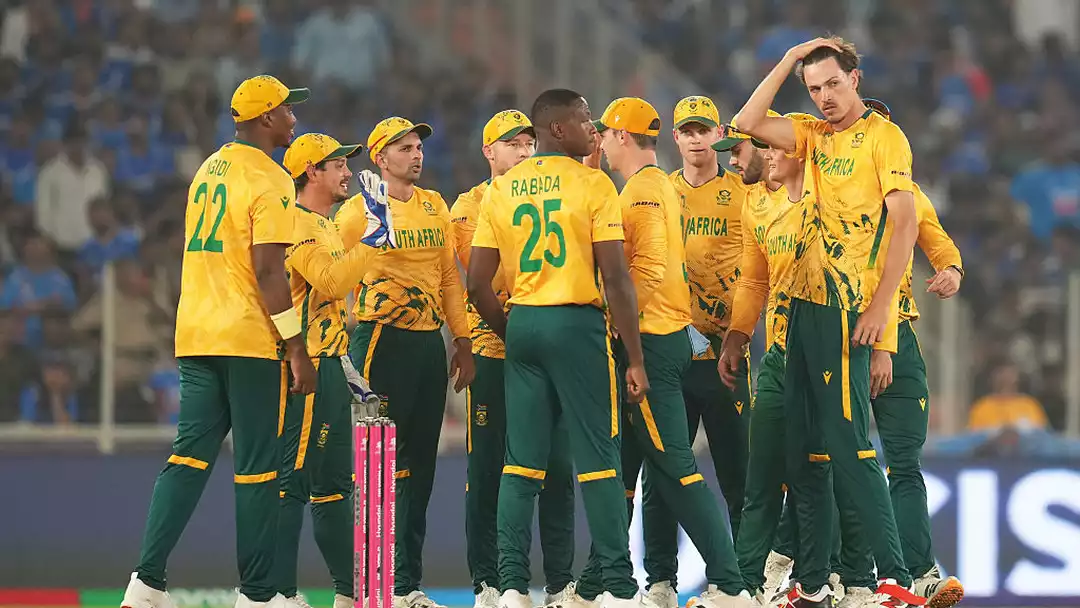
For 826 days, India had moved through ICC white-ball tournaments with the assurance of a champion side. Seventeen consecutive wins. Two global titles. An aura that suggested inevitability. But at the Narendra Modi Stadium, where glory and heartbreak have both left their imprint, that run came crashing down in emphatic fashion.
In their Super Eights opener against South Africa, India were outplayed in all departments and handed a 76-run defeat — their biggest loss by runs in T20 World Cup history. Chasing 187 for victory, the batting unit that had powered their dominance over the past two years fell apart against a disciplined and incisive South African attack.
Familiar Patterns, Painful Outcome
Asked to chase for the first time in this T20 World Cup, India’s innings unraveled almost immediately. Ishan Kishan fell for a duck in the first over, undone by Aiden Markram’s offspin. The early dismissal set the tone. Abhishek Sharma, struggling to find fluency, played and missed repeatedly before eventually holing out. Tilak Varma’s dismissal — charging down the track only to edge behind — compounded the chaos.
At 26 for 3, India were already in survival mode.
The architect of much of their misery was Marco Jansen. The tall left-armer, who had troubled India in the recent Test series, delivered a devastating spell of 4 for 22. Extracting bounce and seam movement from a responsive surface, he dismantled the middle order with calculated precision. A cleverly disguised knuckleball accounted for Abhishek, while his earlier breakthroughs ensured India never settled.
When Corbin Bosch removed Washington Sundar and Suryakumar Yadav in quick succession, India slumped to 51 for 5. From there, the collapse gathered pace. Keshav Maharaj’s three-wicket burst in the 16th over extinguished any faint hopes of a miraculous turnaround.
India were bowled out for 111 in 18.5 overs, conceding a heavy net run rate dent (-3.80) that could have significant implications in a tightly contested Super Eights group.
A Surface That Told a Different Story
Only two months earlier, India had piled up 231 against this same opposition at this venue. But this pitch was a different beast altogether. The black soil surface, flecked with grass and visible cracks, offered grip and uneven bounce. Markram read it correctly at the toss and chose to bat first — a bold call in Indian conditions.
Initially, India made that decision look questionable.
Jasprit Bumrah struck twice in the Powerplay, dismissing Quinton de Kock with a sharp seam-up delivery and deceiving Ryan Rickelton with a slower ball that induced a leading edge. Arshdeep Singh joined the act by removing Markram. At 20 for 3, South Africa were wobbling.
Miller and Brevis Shift the Momentum
Enter David Miller.
With calculated aggression, Miller counterattacked. He targeted Varun Chakaravarthy and Arshdeep, finding boundaries with clinical timing. Dewald Brevis complemented him with fearless strokeplay. Together, they stitched a 97-run partnership that flipped the narrative.
By the end of the Powerplay, South Africa had clawed back to 41. As spin was introduced, Miller and Brevis stood tall on the back foot, punishing anything marginally overpitched. Hardik Pandya’s overstep proved costly as Miller dispatched the resulting free-hit into the stands.
The partnership finally ended when Shivam Dube induced a miscued short ball from Brevis. But Miller, unfazed, completed a 26-ball half-century and ensured the momentum stayed firmly with South Africa.
At 144 for 4 after 15 overs, a total near 200 loomed.
ALSO READ –BCB Bans Monjurul Islam
Late Fightback, Final Flourish
India did mount a late surge. Suryakumar Yadav’s gamble to give Chakaravarthy another over paid off when Miller holed out to long-off. The wicket also extended Chakaravarthy’s streak to 18 consecutive T20I innings with at least one wicket, surpassing Arshdeep’s previous Indian record of 17.
Bumrah, exceptional yet again, returned to produce two outstanding overs, finishing with 3 for 15. Arshdeep removed Jansen to briefly stall South Africa’s acceleration.
But Tristan Stubbs ensured a powerful finish. Taking 20 runs off Hardik Pandya in the final over — including two sixes — Stubbs propelled South Africa to 187 for 7, a total that proved well beyond India’s reach.
Bigger Questions for India
This loss exposed vulnerabilities in India’s approach when chasing under pressure on challenging surfaces. The top order’s technical frailties against seam movement and spin were laid bare. Shot selection lacked clarity. Intent turned into recklessness.
Yet, it would be premature to dismiss a team that has mastered this format over the last two years. T20 cricket is notoriously volatile. A single off-day can dismantle even the most formidable streaks.
However, the margin of defeat — and the net run rate damage — means India’s path to the semifinals is now precarious. Upcoming fixtures in Chennai and Kolkata carry enormous weight. Another misstep could abruptly end their title defense.
For South Africa, this victory reinforces their credentials as serious contenders. For India, it serves as a sobering reminder: dominance in T20 cricket is never permanent, and the format punishes complacency without mercy.