

Chennai has always embraced good cricket, and on Friday evening at Chepauk, the crowd once again proved why it remains one of the most passionate venues in the game. Nearly 20,000 fans turned up to witness an Associate battle between the Netherlands and the United States in the T20 World Cup — and they were treated to a statement performance from the Americans.
A day earlier, Dutch all-rounder Logan van Beek had spoken about hoping for strong local support. He mentioned how the Netherlands often become the “second favourite team” for neutral fans and hoped that the Chennai faithful would get behind them. He also spoke about wanting to defeat the USA and head into their final group game against India with a chance to do something special.
The Chennai crowd did its part. Just as it had for earlier fixtures in the tournament, it showed up in impressive numbers. There were cheers for every sharp fielding effort and quality stroke from both sides. Interestingly, there were also loud chants of “USA! USA!” echoing across the stadium, reflecting the connection many fans felt with American players of Indian origin.
However, while the atmosphere matched expectations, the Netherlands’ performance did not.
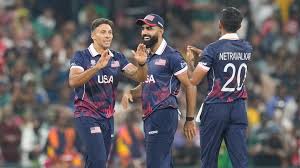
USA’s Bold Moves Pay Off
Coming into the match, the Dutch were favourites. They won the toss and opted to bowl, a logical choice at a venue where chasing has often been successful in recent T20 games. But the United States had other plans.
In a surprise move, the USA left out experienced campaigner Andries Gous, despite his strong track record, including a memorable century in the ILT20 and solid performances in the previous World Cup. Instead, the Americans reshuffled their opening combination for the third time in as many matches. Captain Monank Patel returned to the top of the order after two lean outings.
The gamble worked.
Monank found rhythm and timing when it mattered most, anchoring the innings confidently. But the real showstopper was 21-year-old Saiteja Mukkamalla. Fearless and technically sound, Mukkamalla took on the Dutch spinners despite the pitch offering grip and turn. His strokeplay against spin was calculated aggression — sweeping hard when required, stepping out to loft over the infield, and refusing to allow the bowlers to dictate terms.
The Netherlands’ spinners, led by Roelof van der Merwe, tried to adapt. Van der Merwe, known for firing the ball in quickly, slowed his pace and gave it more air to extract maximum turn. The ball responded, drifting and gripping off the surface. But the USA batters read it early and attacked decisively.
By the end of 20 overs, the United States had piled up 196 — the highest total at the venue in this year’s T20 World Cup. It was a commanding score, perhaps even above par given the nature of the pitch.
Netherlands coach Ryan Cook admitted as much after the game. He acknowledged that while it was a good batting surface, 195-plus was slightly more than they should have conceded. Execution with the ball, he noted, was below the expected standard.
ALSO READ- Zimbabwe Shock Australia with All-Round Brilliance at the T20 World Cup
Spin Decides the Contest
If the first innings belonged to Mukkamalla and Monank, the second was owned by Harmeet Singh.
The Dutch entered the chase hoping dew would ease conditions under lights. It didn’t. Instead, the pitch continued to assist spin, and Harmeet exploited it brilliantly.
In an interesting tactical adjustment, Harmeet reduced his average pace by nearly 8 kmph compared to his earlier matches in the tournament. Rather than pushing the ball through, he floated it generously, inviting the batters to attack. The ploy worked perfectly. With runs on the board, he had the luxury of tossing it up and waiting for mistakes.
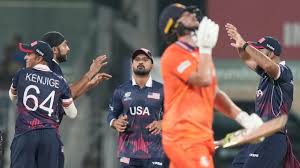
Colin Ackermann was dismissed for a golden duck. Max O’Dowd couldn’t anchor the innings. While Bas de Leede showed intent and briefly looked capable of launching a rescue act, he lacked sustained support. In the blink of an eye, 41/1 became 84/7. The required rate ballooned, scoreboard pressure mounted, and the outcome became inevitable.
Harmeet finished with a four-wicket haul and deservedly claimed the Player of the Match award. Alongside him, spinners Mohammad Mohsin and Nosthush Kenjige maintained tight lines, collectively strangling the Dutch batting unit. Remarkably, while Netherlands spinners had generated more average turn and drift earlier in the evening, they went wicketless and conceded 12 runs per over. In contrast, the American trio picked up seven wickets at just six runs per over.
A Historic Result with Big Implications
This victory marked the United States’ first-ever win over the Netherlands in international cricket across formats — a significant milestone for a rapidly improving side.
For the Dutch, the defeat complicates their campaign. Until Friday evening, they were viewed as potential disruptors capable of upsetting the group hierarchy and possibly denying either India or Pakistan a Super 8 berth. A win here would have made their upcoming clash in Ahmedabad far more intriguing.
Instead, the Netherlands now find themselves level on points with the USA but trailing on net run rate. Momentum has shifted decisively. In tournament cricket, such swings can redefine group narratives within hours.
The broader takeaway is the rise of Associate teams capable of delivering high-quality, fearless cricket on the global stage. The USA not only out-batted the Netherlands but also out-thought and out-executed them tactically. Their adaptability against spin and clarity in bowling plans under pressure demonstrated maturity beyond expectations.
As for the Chennai crowd, they witnessed more than just a match. They saw history being written.
And while Logan van Beek got his wish for strong support in the stands, the result on the field was not what he had envisioned. In a World Cup where margins are slim and momentum fragile, three hours of cricket have reshaped the group dynamics.
The decks, for now, appear cleared for the tournament heavyweights. But if Friday proved anything, it is this: underestimating Associate teams in modern T20 cricket is a mistake no contender can afford to make.