

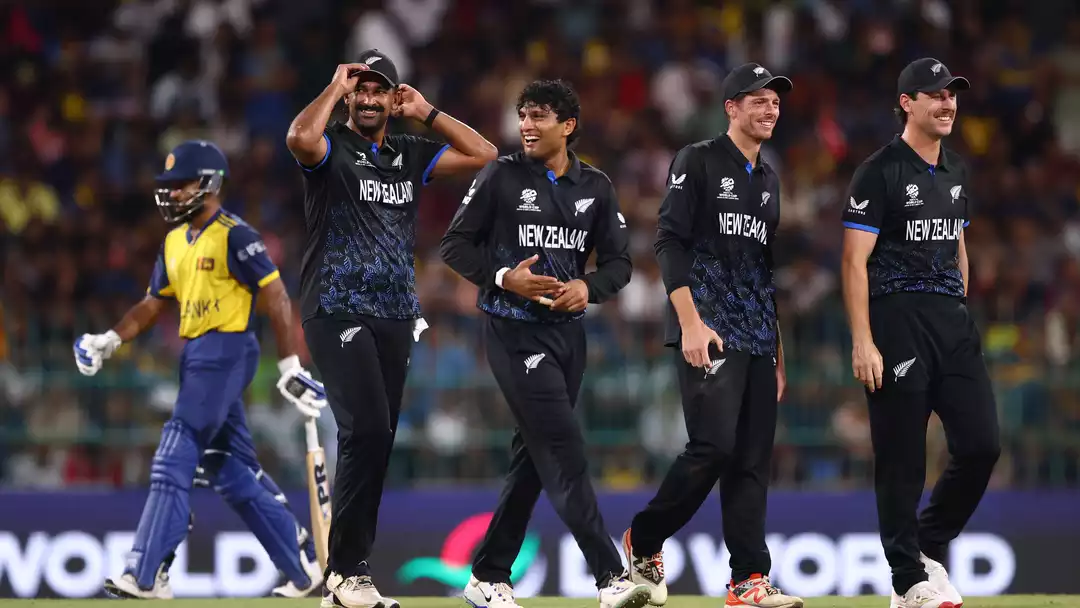
Sri Lanka’s T20 World Cup journey came to an abrupt end at the R. Premadasa Stadium as New Zealand produced a clinical, spin-driven performance to secure a commanding 61-run victory. What began as a calculated decision by the hosts to chase under lights turned into a tactical misread, with conditions refusing to cooperate and New Zealand capitalising ruthlessly.
Winning the toss, Sri Lanka opted to field, anticipating the ball would skid on better in the second innings. Instead, the pitch slowed progressively, gripping enough to reward controlled spin and clever variations — precisely the formula Sri Lanka themselves have used so effectively at home over the years.
Collapse and Counterattack: New Zealand’s Rollercoaster Innings
New Zealand’s innings was defined by two contrasting phases.
They began briskly, even as Dilshan Madushanka extracted early swing. However, momentum shifted quickly when Maheesh Theekshana removed Finn Allen and later struck twice in rapid succession. Dunith Wellalage compounded the damage by bowling Daryl Mitchell with a sharp arm ball, leaving New Zealand in disarray at 84 for 6 after being comfortably placed at 75 for 2.
Amid the turbulence, Rachin Ravindra had earlier shown intent, using his reach to target the straight boundary against Dushan Hemantha. Glenn Phillips also threatened before falling to Dushmantha Chameera. But once the collapse set in, composure became critical.
That stability came from captain Mitchell Santner and Cole McConchie. Initially cautious, McConchie crawled to 3 off 12 deliveries, absorbing pressure as Sri Lanka tightened their grip. But the momentum swung dramatically in the final overs.
The 17th over proved decisive. McConchie launched Chameera for two sixes and a four, shifting the tempo. Santner followed by dismantling Theekshana with two towering sixes in a 21-run over. New Zealand plundered 70 runs in the final four overs, transforming a precarious position into a competitive 168 for 7. From 84 for 6, the turnaround was emphatic.
Henry’s Early Blow Sets the Tone
Defending 168 required early breakthroughs, and Matt Henry delivered immediately. He uprooted Pathum Nissanka with the first ball of the innings via a sharp in-ducker and followed it up with a wicket maiden. His cleverly disguised slower ball then accounted for Charith Asalanka.
Sri Lanka limped to 20 for 2 in the Powerplay — the slowest start of the tournament — immediately placing them behind the required rate on a pitch offering increasing assistance to spinners.
ALSO READ –Brook’s Historic T20I Hundred Sends England into Semis
Ravindra’s Spin Masterclass
As the asking rate climbed, New Zealand tightened the noose through spin.
Ravindra returned to the spotlight with a match-defining spell. He lured Kusal Mendis and Pavan Rathnayake into expansive strokes, drawing them out of their crease and into stumpings. He then dismissed Dasun Shanaka and Hemantha, both attempting to force the pace against the turn. His final figures of 4 for 27 effectively ended Sri Lanka’s hopes.
While Kamindu Mendis top-scored with 31, boundaries were scarce and momentum never materialised. The pressure was relentless. New Zealand were so comfortable relying on spin that Lockie Ferguson bowled just one over, while Henry did not return for a second spell.
Tactical Miscalculation and Tournament Consequences
Sri Lanka’s decision at the toss proved costly. Expecting dew and easier batting conditions, they instead encountered a deteriorating surface that demanded patience and precision — qualities New Zealand displayed in abundance.
The 61-run margin not only confirmed Sri Lanka’s elimination but also reshaped the group’s qualification dynamics, tightening the net run rate equation for Pakistan.
In the end, the match was decided not by raw power but by adaptability. New Zealand assessed conditions better, managed their collapse with maturity, and exploited spin with calculated discipline. On a surface that rewarded tactical awareness, they delivered a performance defined by clarity, control and composure — leaving Sri Lanka to reflect on what might have been.