

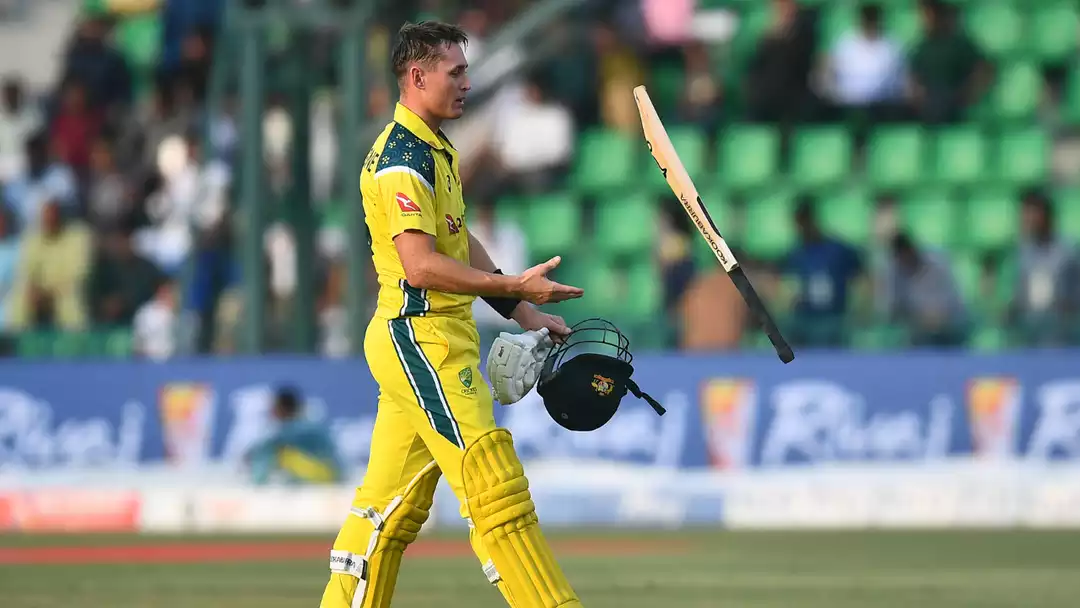
Marnus Labuschagne has been left out of Australia’s ODI squad for the upcoming tours of Zimbabwe and South Africa after a prolonged run of poor form across formats.
The experienced batter has struggled to produce consistent performances in recent months, and Australia’s selectors have opted to give younger players an opportunity as the team begins its preparations for next year’s World Cup.
Labuschagne’s omission comes after a disappointing ODI tour of Pakistan, where he managed only 24 runs across three matches. His returns were not significantly better against Bangladesh, where he scored just one half-century in three ODIs in Mirpur.
His recent struggles continued in the two-Test home series against Bangladesh, further increasing the pressure on his place in Australia’s limited-overs plans.
Labuschagne Pays the Price for Poor ODI Form
Labuschagne has been an important part of Australia’s batting group in recent years, but his recent numbers have not been strong enough to guarantee selection.
The three-match ODI series in Pakistan proved particularly difficult. Across the series, the right-hander could score only 24 runs, failing to make a meaningful contribution to Australia’s batting effort.
He then had limited success during the ODI series against Bangladesh in June. Although Labuschagne managed to register a half-century, he could not convert his starts into regular scores.
With Mitchell Marsh and Travis Head returning to the ODI setup, competition for batting positions has increased considerably. The selectors ultimately decided that Labuschagne would miss out.
His absence is therefore not simply a reflection of one poor series but the result of a wider dip in form.
Also Read-Mayank Agarwal Joins Durham
Australia Opt for Youth
While Labuschagne has been left out, Australia have continued their strategy of exposing younger players to international cricket.
Joel Davies is among the players who could benefit most from the decision. The allrounder impressed during his T20I debut against Bangladesh, taking 3 wickets for 17 runs.
Davies is now in contention to make his ODI debut and could become another young player to establish himself in Australia’s white-ball setup.
Left-handed batter Ollie Peake has also retained his place after making his ODI debut against Pakistan in May.
The selectors clearly see both players as part of Australia’s longer-term plans, and the upcoming six-match ODI campaign provides them with valuable opportunities to gain experience.
Mitchell Marsh to Captain Australia in Zimbabwe
Mitchell Marsh will captain Australia during the Zimbabwe leg of the tour.
His return is a significant boost for the Australian ODI side, both because of his batting ability and his allround contribution.
Travis Head will also return to the squad, giving Australia another aggressive option at the top of the order.
The combination of Marsh and Head should strengthen Australia’s batting considerably and gives the team additional flexibility with both players capable of influencing matches with either bat or ball.
The squad will then undergo further changes when Australia travel to South Africa.
Cummins and Starc to Join in South Africa
Pat Cummins and Mitchell Starc will join the Australian group for the South African portion of the tour.
Josh Hazlewood will also return for both series, providing Australia with another experienced fast-bowling option.
The presence of Hazlewood, Cummins and Starc in South Africa will give the Australian attack considerable experience ahead of the three-match Test series that follows the ODI fixtures.
Their involvement also underlines the importance Australia is placing on the upcoming tours.
A Key Six-Match World Cup Preparation
Australia’s selectors view the six-match ODI series against Zimbabwe and South Africa as an important part of the preparation for next year’s World Cup.
Interestingly, the World Cup will be played in the same countries, making the upcoming matches particularly valuable.
Australian selectors will have the opportunity to assess players in conditions similar to those they will face during the tournament.
Chair of Selectors George Bailey described the series as an important lead-in to the World Cup.
“This six-game series is an important lead-in to next year’s World Cup, being played in the same countries,” Bailey said.
He also highlighted the importance of having experienced players such as Marsh, Head and Hazlewood return to the squad while continuing to develop younger members of the team.
Opportunity Knocks for Joel Davies and Ollie Peake
For Davies and Peake, the upcoming tours could represent an important stage in their development.
Davies has already shown his potential in the shortest format, producing impressive figures of 3/17 on his T20I debut in Bangladesh.
An ODI debut would provide him with a different challenge. The 50-over format requires greater adaptability, particularly when managing innings with the bat and bowling different phases of the game.
Peake, meanwhile, already has one ODI appearance under his belt. Retaining his place gives him an opportunity to build on that experience and demonstrate that he can become a regular part of Australia’s future plans.
Bailey said both young players are highly regarded within the Australian setup.
For Australia, providing them with international exposure now could prove valuable when the team begins finalising its World Cup squad.
What Does This Mean for Labuschagne?
Labuschagne’s omission does not necessarily mean the end of his ODI career.
At 30, he still has significant experience and remains capable of returning to the Australian setup if he can rediscover his form.
His strong record in domestic and international cricket means he is unlikely to be forgotten by the selectors. However, the competition for places is becoming increasingly intense.
Australia have several established batters, while younger players are now being given opportunities to prove themselves.
For Labuschagne, the immediate challenge will be to return to run-scoring form and put pressure on the selectors through his performances at the domestic level.
His ability to respond to setbacks will be closely watched.
Australia’s ODI Squad
Australia’s squad for the Zimbabwe and South Africa tours includes Xavier Bartlett, Alex Carey, Cooper Connolly, Pat Cummins, Joel Davies, Nathan Ellis, Cameron Green, Josh Hazlewood, Travis Head, Josh Inglis, Spencer Johnson, Mitchell Marsh, Oliver Peake, Matthew Renshaw, Billy Stanlake, Mitchell Starc and Adam Zampa.
The squad combines experienced international players with emerging talent, reflecting Australia’s dual focus on immediate results and long-term preparation.
A New Phase for Australia’s ODI Team
Labuschagne’s omission is one of the biggest talking points from Australia’s squad announcement, but the larger story is the team’s transition ahead of the World Cup.
The return of several senior players gives Australia greater experience, while the inclusion of Davies and Peake provides opportunities for the next generation.
The Zimbabwe and South Africa tours will therefore be more than a routine bilateral assignment. They will give Australia an opportunity to test combinations, assess young players and understand conditions that will be crucial at next year’s World Cup.
For Labuschagne, meanwhile, the message from the selectors is clear: places in the Australian ODI team cannot be taken for granted.
A strong run of performances could put him back in contention, but for now, Australia have chosen to move forward with a combination of proven performers and emerging talent.
With six ODIs ahead and a major global tournament on the horizon, the upcoming tours could play a significant role in determining the shape of Australia’s World Cup squad.