

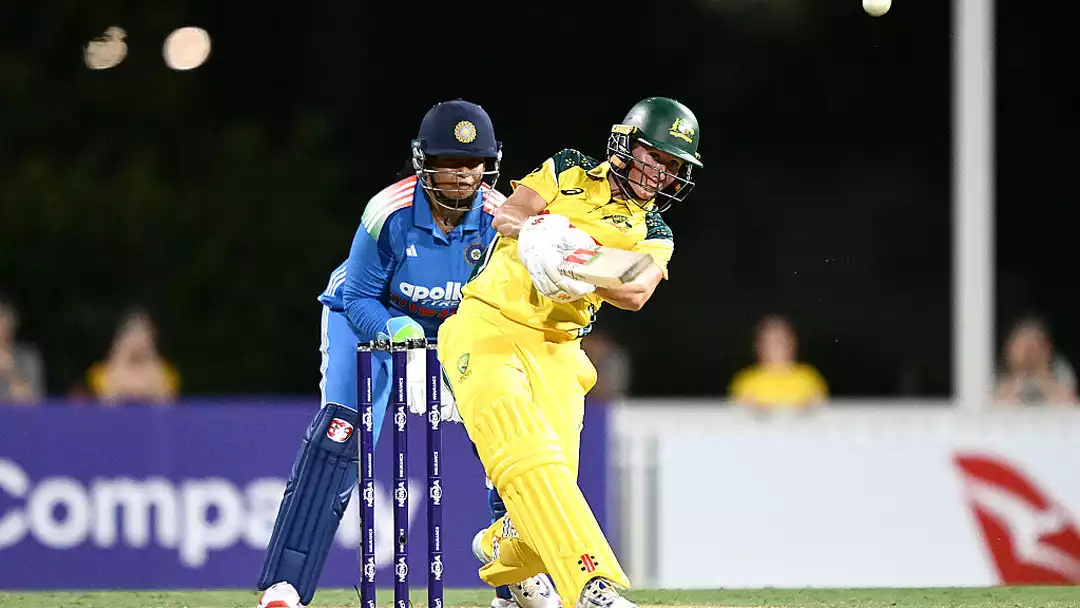
Playing their first ODI since lifting the World Cup in November, the India women’s national cricket team were brought back down to earth by a clinical Australian side, going down by six wickets in the series opener at the Allan Border Field on Tuesday.
The defeat handed the Australia women’s national cricket team early control in the ODI leg of the multi-format series, even as the overall contest remains locked at four points apiece following India’s 2-1 T20I success.
Batting First, but on the Back Foot
Harmanpreet Kaur’s call to bat first after winning the toss appeared proactive but quickly unravelled on a surface offering steep bounce and seam movement. Megan Schutt struck in just her second delivery, trapping Pratika Rawal in front for a duck. The early wicket set the tone for an innings that never truly gathered fluency.
Shafali Verma, promoted to No. 3, struggled to impose herself and fell cheaply, while Jemimah Rodrigues followed soon after. At 52 for 3, India were already negotiating a recovery phase rather than building momentum.
The stabilising influence came from Smriti Mandhana, who crafted a composed 58 off 68 deliveries. Timing through the off side was crisp, and her 48-run partnership with Harmanpreet Kaur restored temporary balance. Yet just as India looked poised to consolidate, Mandhana miscued a sweep off Tahlia McGrath and was caught at deep backward square leg.
From that point onward, Australia tightened their grip.
Spin Squeeze and Slowing Tempo
Deepti Sharma’s dismissal compounded India’s slide, and the scoring rate dipped alarmingly. Alana King extracted sharp turn and bounce, while Ashleigh Gardner’s control in the middle overs proved decisive. The Australian spinners consistently hit the surface hard, exploiting the extra grip available.
Richa Ghosh’s brisk potential never materialised, and Harmanpreet, battling discomfort in her left knee, required 79 deliveries to reach her half-century. The lack of acceleration in overs 30 to 40 proved costly, particularly on a surface that eased slightly under lights.
An unexpected late flourish came from Kashvee Gautam, whose enterprising 43 included three fours and three sixes. Her fearless strokeplay provided India with a semblance of impetus toward the back end.
A moment of anxiety in the 45th over—when Kranti Gaud’s bat stuck in the turf while turning back from a non-existent single—evoked unwanted memories from past ICC heartbreaks. Though she survived that incident, she fell in the following over to Gardner, who finished with three wickets. Gardner also effected a direct-hit run-out to dismiss Kashvee, ensuring India were bowled out for 214 with eight balls unused.
Australia’s Composed Chase
Australia’s reply began with authority. Alyssa Healy and Phoebe Litchfield put together a 55-run opening stand, negating India’s new-ball seamers who struggled to extract comparable movement.
Spin brought India back briefly. Shree Charani struck twice in quick succession, dismissing Litchfield with a well-disguised delivery that led to a stumping and then inducing Georgia Voll to chip a catch to Mandhana at extra cover. Suddenly, Australia were 55 for 2, and the contest reopened.
However, Australia’s depth and composure surfaced quickly.
Healy combined with Beth Mooney for a 64-run stand that wrestled back control. Healy reached a fifty in what was her final international appearance in Brisbane before falling immediately after the milestone, courtesy of a sharp catch from Rodrigues at backward point.
Mooney, unfazed, paced her innings expertly. Rotating strike with precision and punishing loose deliveries, she brought up a fluent half-century that kept Australia comfortably ahead of the required rate.
ALSO READ –India’s blind cricket champions finally get the reward they deserve!
Missed Opportunities Seal India’s Fate
India’s final window of opportunity arrived when Shafali Verma was introduced. Annabel Sutherland miscued a half-tracker, but Kashvee Gautam spilled a straightforward chance at deep mid-wicket. That drop effectively extinguished any lingering hope.
Mooney eventually chipped to Mandhana, but by then Australia were within touching distance. Sutherland fittingly sealed the victory with a six, as the hosts reached 217 for 4 with 70 deliveries remaining.
Tactical and Structural Takeaways
India’s defeat highlighted several technical and tactical concerns:
-
Top-order instability against bounce and lateral movement.
-
Middle-overs stagnation, particularly against quality spin.
-
Limited new-ball penetration in Australian conditions.
-
Fielding lapses at critical junctures.
Australia, despite missing Ellyse Perry and Kim Garth due to quad injuries, demonstrated squad depth and tactical clarity. Their spinners controlled tempo, and their batters navigated phases with calculated calm.
With two ODIs remaining — the next in Hobart on February 27 — India have an opportunity to recalibrate. Adjusting to Australian surfaces, improving rotational strike in the middle overs, and sharpening execution with the ball will be immediate priorities.