

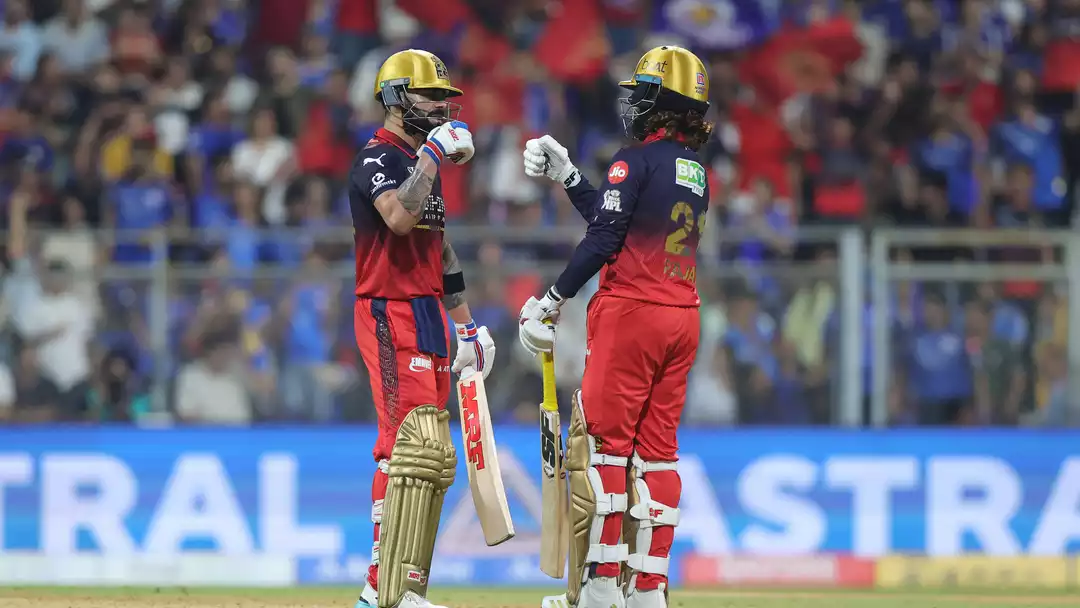
Royal Challengers Bengaluru (RCB) produced a high-impact, all-round performance to defeat Mumbai Indians by 18 runs at the Wankhede Stadium, reaffirming their credentials as serious contenders in IPL 2026. In a game dominated by aggressive stroke play and shifting momentum, RCB’s ability to sustain pressure across all phases proved decisive.
A blistering start sets the tone
The foundation of RCB’s imposing total of 240/4 was laid by Phil Salt, who delivered a breathtaking innings of 78 off just 36 balls. From the outset, Salt displayed attacking intent, taking on both pace and spin with remarkable ease. His clean striking, especially against bowlers like Mitchell Santner, ensured RCB dominated the Powerplay. By the end of six overs, RCB had raced to 71 without loss, putting Mumbai immediately on the back foot.
At the other end, Virat Kohli played the perfect complementary role. While Salt dictated terms, Kohli anchored the innings with composure and precision. His 38-run knock might not stand out statistically, but it was vital in maintaining continuity. The 120-run opening partnership effectively neutralized Mumbai’s bowling attack and gave RCB a launchpad for a massive total.
Middle-overs acceleration defines the innings
The dismissal of Salt did little to slow RCB’s momentum, thanks to the arrival of Rajat Patidar. Known for his aggressive intent, Patidar turned the middle overs into a continuation of the Powerplay. His explosive 53 off just 20 deliveries dismantled Mumbai’s spin options and ensured the scoring rate remained above 12 runs per over.
Patidar’s innings was particularly significant because it eliminated the traditional slowdown phase that many teams experience. By consistently finding boundaries and rotating strike efficiently, he kept the pressure firmly on Mumbai’s bowlers, leaving them with limited tactical options.
Clinical finishing pushes RCB beyond reach
The finishing responsibilities were expertly handled by Tim David, who added the final flourish with an unbeaten 34 off 16 balls. His calculated aggression in the death overs ensured RCB crossed the 240-run mark—often considered a match-winning total even on batting-friendly surfaces.
David’s contribution underlined a key aspect of modern T20 cricket: the importance of maximizing the final overs. His ability to capitalize on loose deliveries and convert them into boundaries ensured Mumbai faced an uphill task right from the start of their chase.
Mumbai’s promising start undone by middle-overs collapse
In response, Mumbai Indians began strongly with Rohit Sharma and Ryan Rickelton providing a brisk start. The duo matched RCB’s intensity during the Powerplay, scoring 62 runs without loss. However, Rohit’s untimely retirement due to a hamstring issue disrupted the rhythm of the innings.
The turning point came in the middle overs when RCB tightened their grip. Suyash Sharma struck crucial blows, dismissing both Rickelton and Tilak Varma in quick succession. These wickets forced Mumbai into a rebuilding phase, allowing the required run rate to escalate beyond control.
Further pressure was applied by Krunal Pandya, whose economical spell and key wicket of Suryakumar Yadav effectively sealed Mumbai’s fate. His disciplined bowling ensured that boundaries were hard to come by during a critical phase of the chase.
Late resistance falls short
Despite the mounting pressure, Sherfane Rutherford produced a remarkable late surge, scoring an unbeaten 71 off 31 balls. His aggressive hitting in the final overs, including multiple sixes, brought some respectability to the scoreline. However, the required rate had climbed too high by then, and his efforts were not enough to bridge the gap.
ALSO READ-Afghanistan Prioritize Rashid Khan’s Longevity, Red-Ball Future in Doubt
Tactical execution the key differentiator
One of the defining aspects of RCB’s victory was their ability to execute plans effectively. While Mumbai relied heavily on individual brilliance, RCB functioned as a cohesive unit. From Salt’s explosive start to Patidar’s middle-overs dominance and David’s finishing touch, every phase of the innings was optimized.
On the bowling front, timely interventions from Suyash Sharma and Krunal Pandya ensured that Mumbai never truly regained control after their initial burst. This balance between aggressive batting and disciplined bowling highlights why RCB emerged as the superior side on the day.
This victory not only boosts RCB’s confidence but also sends a strong message to other teams in the tournament. Their ability to recover from setbacks and deliver a complete performance reflects a well-rounded unit capable of adapting to different match situations. For Mumbai Indians, the loss underscores the need for better middle-overs management and injury resilience.
As the tournament progresses, performances like these could define the trajectory of both teams—RCB building momentum, and Mumbai seeking answers to regain consistency.